
Beginner's Guide to Vaping 2026: Everything You Need to Know
Posted by JOHN Williams on 13th May 2026
If you've been curious about vaping but don't know where to start, you're not alone. With thousands of devices, flavors, and nicotine options flooding the market in 2026, walking into a vape shop for the first time can feel completely overwhelming.
This guide cuts through the noise. Whether you're a smoker looking to switch, or simply curious about what vaping actually is, we've put together the most comprehensive, beginner-friendly breakdown available online today — written in plain English, with zero fluff.
? Table of Contents
- What Is Vaping? The Simple Answer
- How Does a Vape Device Actually Work?
- Types of Vape Devices in 2026
- Choosing Your First Device: The Complete Beginner's Checklist
- Understanding Vape Juice (E-Liquid): What's in It?
- Nicotine Levels Explained
- How to Vape Correctly: Inhaling Techniques
- Common Beginner Mistakes (And How to Avoid Them)
- Vaping Safety: What Every Beginner Must Know
- Vaping Laws & Regulations in 2026
- How Much Does Vaping Cost? A Real Budget Breakdown
- FAQ: Your Beginner Questions Answered
1. What Is Vaping? The Simple Answer
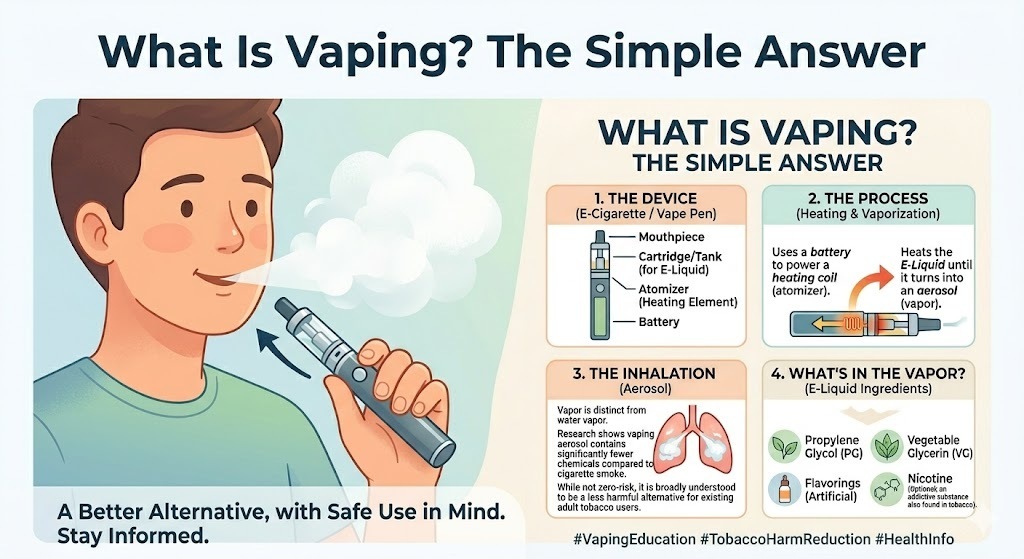
Vaping is the act of inhaling vapor produced by an electronic device — commonly called a vape, e-cigarette, mod, or pod system. Instead of burning tobacco like a traditional cigarette, vape devices heat a liquid (called e-liquid or vape juice) to produce an aerosol vapor that you inhale.
The key difference: no combustion, no smoke, no ash.
Vaping became mainstream in the early 2010s and has evolved dramatically. By 2026, the global vaping market is estimated at over $40 billion, with technology advancing every single year.
? Quick Fact: Vaping was originally developed as a smoking cessation tool by a Chinese pharmacist named Hon Lik in 2003. Today, it serves millions of users across a wide range of lifestyles and preferences.
2. How Does a Vape Device Actually Work?
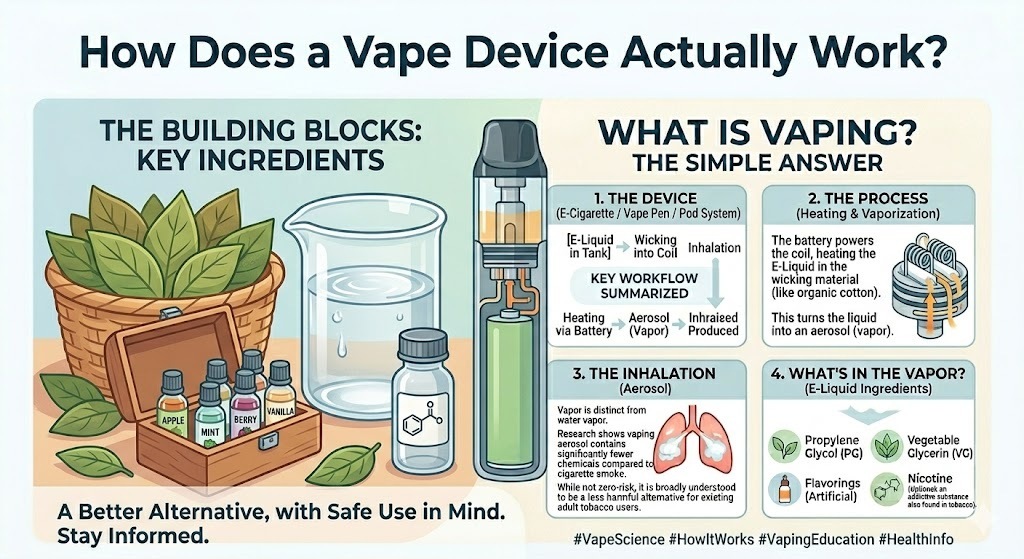
Understanding the mechanics helps you make smarter choices. Here's the simple breakdown:
The Core Components of Any Vape:
| Component | What It Does |
|---|---|
| Battery / Mod | Powers the device; can be built-in or replaceable |
| Atomizer / Coil | Heats up to vaporize the e-liquid |
| Tank / Pod / Cartridge | Holds the e-liquid |
| Mouthpiece (Drip Tip) | Where you inhale the vapor |
| E-Liquid | The liquid that gets vaporized |
The Process in 3 Steps:
- You press the fire button (or simply inhale on draw-activated devices)
- The battery sends power to the coil, which heats up rapidly
- The coil vaporizes the e-liquid, and you inhale the resulting vapor
Modern devices in 2026 often feature smart chips that regulate temperature, prevent dry hits, and optimize power delivery for the best possible experience.
3. Types of Vape Devices in 2026
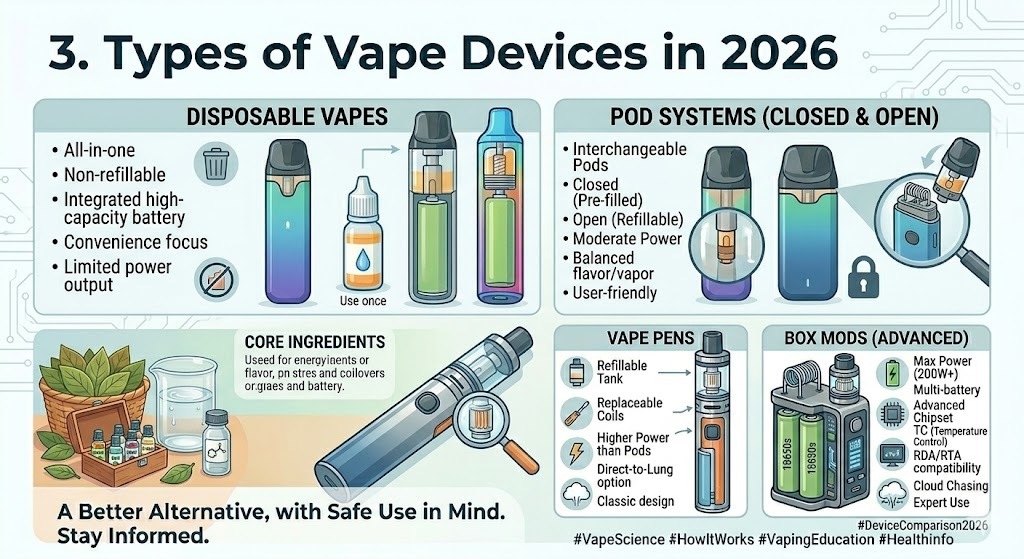
This is where beginners get most confused. Here's every major device category explained clearly:
? Disposable Vapes
Best for: Absolute beginners, occasional users, travelers
Disposable vapes are pre-filled, pre-charged, and ready to use out of the box. When the e-liquid or battery runs out, you throw it away. Simple as that.
✅ Pros: Zero setup, ultra-portable, low upfront cost, huge flavor variety
❌ Cons: Expensive long-term, environmental waste, not refillable
Top Picks in 2026: Lost Mary BM600S Pro, Elf Bar BC10000, Hayati Pro Ultra 15000
? Pod Systems (Closed & Open)
Best for: Most beginners making the switch from cigarettes
Pod systems are the most popular beginner device category in 2026. They use replaceable or refillable pods that click into a small, compact device.
- Closed pod systems use pre-filled pods (easy, no mess)
- Open pod systems let you fill your own e-liquid (more control, cheaper long-term)
✅ Pros: Compact, easy to use, great nicotine delivery, affordable devices
❌ Cons: Limited customization, ongoing pod replacement costs
Top Picks in 2026: SMOK Nord Pro, Vaporesso Xros 4 Mini, Uwell Caliburn G3 Pro
? Vape Pens
Best for: Beginners who want slightly more vapor production
Vape pens are slim, cylindrical devices that bridge the gap between beginner and intermediate vaping. They typically feature a refillable tank and a fixed or variable output.
✅ Pros: Good vapor production, easy to refill, affordable
❌ Cons: Slightly bulkier than pod systems, requires some maintenance
? Box Mods (Advanced)
Best for: Experienced vapers — NOT recommended for beginners
Box mods are high-powered devices with extensive customization options. They produce massive clouds and intense flavor but come with a steep learning curve. Skip this category until you have at least 3–6 months of experience.
4. Choosing Your First Device: The Complete Beginner's Checklist
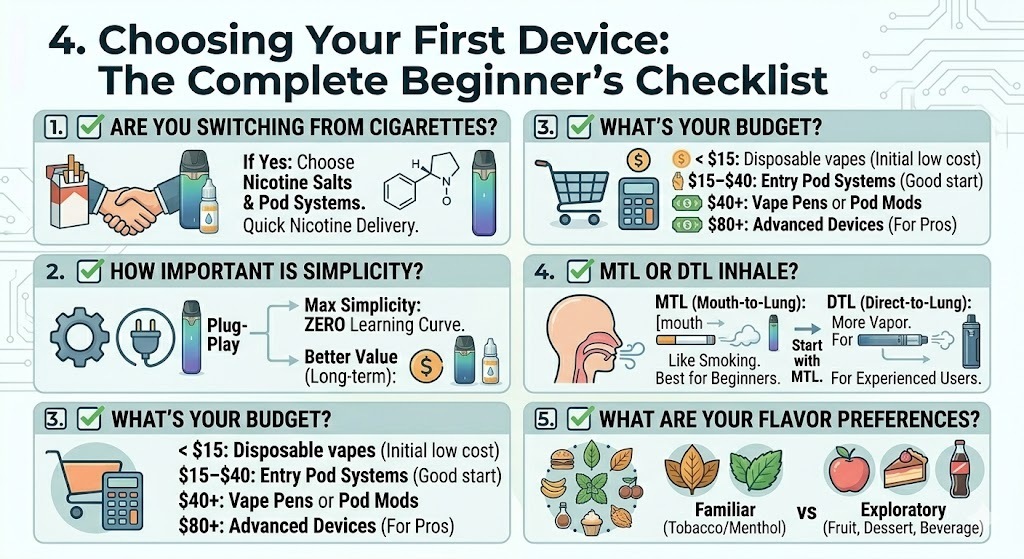
Before you buy anything, answer these five questions:
✅ Question 1: Are You Switching from Cigarettes?
If yes, nicotine salt pod systems are your best match. They deliver nicotine quickly and smoothly, closely mimicking the sensation of smoking.
✅ Question 2: How Important Is Simplicity?
If you want zero learning curve, start with a disposable vape or a closed pod system. If you're comfortable with a little setup, an open pod system gives better long-term value.
✅ Question 3: What's Your Budget?
- Under $15: Disposable vapes
- $15–$40: Entry-level pod systems
- $40–$80: Mid-range pod systems or vape pens
- $80+: Advanced devices (not recommended for beginners)
✅ Question 4: MTL or DTL?
- MTL (Mouth-to-Lung): Draw vapor into your mouth first, then into your lungs — just like smoking a cigarette. Best for beginners and nicotine users.
- DTL (Direct-to-Lung): Inhale vapor directly into your lungs in one motion. Produces more vapor but uses less nicotine.
As a beginner, start with MTL.
✅ Question 5: Flavors or Tobacco/Menthol?
If you're coming from cigarettes, tobacco or menthol flavors may feel more familiar at first. As you settle in, the world of fruit, dessert, and beverage flavors becomes endlessly enjoyable.
5. Understanding Vape Juice (E-Liquid): What's in It?
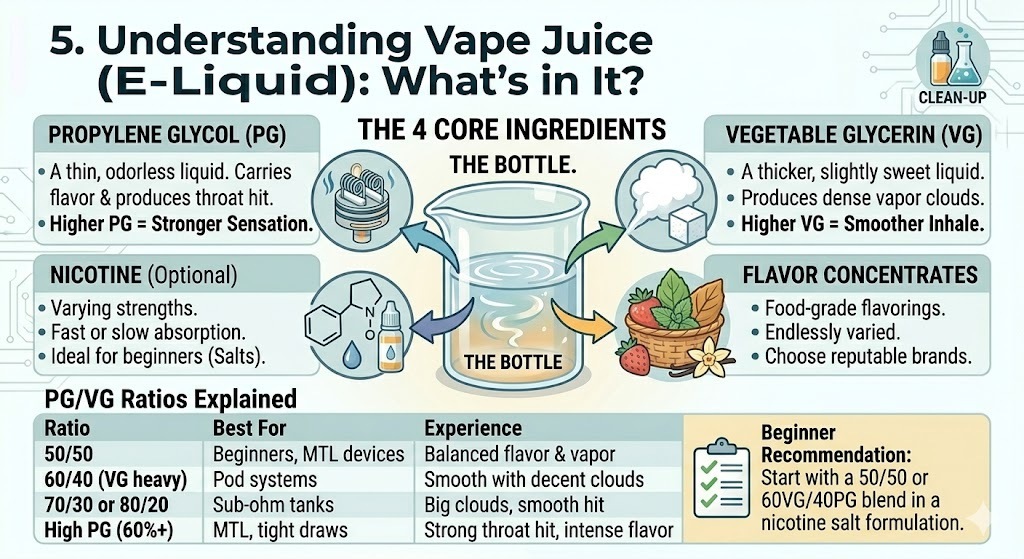
E-liquid is the fuel of your vape. Understanding what's in it removes the mystery and helps you shop smarter.
The 4 Core Ingredients:
1. Propylene Glycol (PG)
A thin, odorless liquid that carries flavor effectively and produces a noticeable throat hit. Higher PG ratios = stronger throat sensation, better flavor, less vapor.
2. Vegetable Glycerin (VG)
A thicker, slightly sweet liquid that produces dense vapor clouds. Higher VG ratios = smoother inhale, bigger clouds, less throat hit.
3. Nicotine (Optional)
Added in varying strengths. Available as freebase nicotine (smoother, slower absorption) or nicotine salts (faster absorption, smoother at high strengths — ideal for beginners).
4. Flavor Concentrates
Food-grade flavorings that create everything from strawberry ice cream to classic Virginia tobacco. Quality varies significantly by brand — always choose reputable manufacturers.
PG/VG Ratios Explained:
| Ratio | Best For | Experience |
|---|---|---|
| 50/50 | Beginners, MTL devices | Balanced flavor & vapor |
| 60/40 (VG heavy) | Pod systems | Smooth with decent clouds |
| 70/30 or 80/20 | Sub-ohm tanks | Big clouds, smooth hit |
| High PG (60%+) | MTL, tight draws | Strong throat hit, intense flavor |
? Beginner Recommendation: Start with a 50/50 or 60VG/40PG blend in a nicotine salt formulation.
6. Nicotine Levels Explained
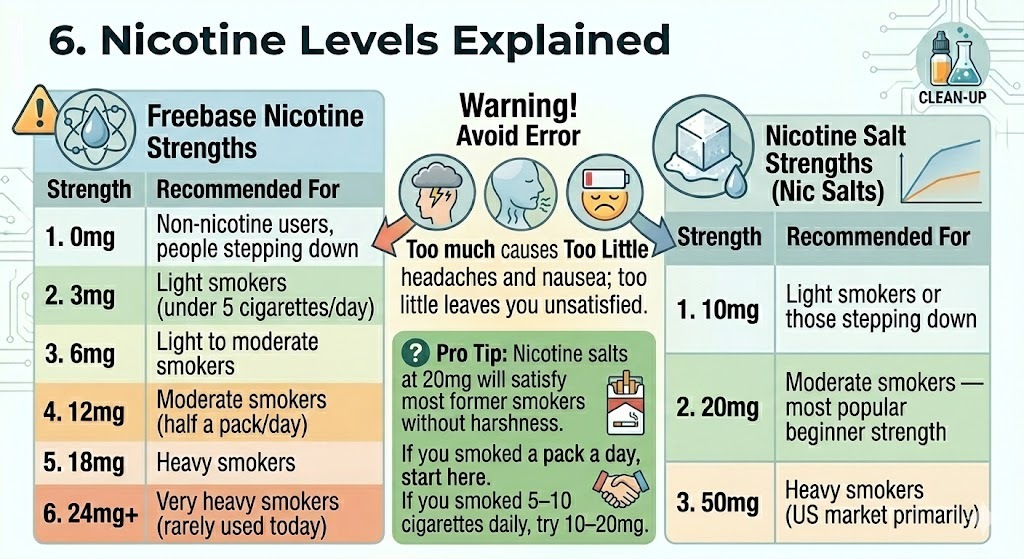
Choosing the wrong nicotine strength is the #1 reason beginners have a bad first experience. Too much causes headaches and nausea; too little leaves you unsatisfied.
Freebase Nicotine Strengths:
| Strength | Recommended For |
|---|---|
| 0mg | Non-nicotine users, people stepping down |
| 3mg | Light smokers (under 5 cigarettes/day) |
| 6mg | Light to moderate smokers |
| 12mg | Moderate smokers (half a pack/day) |
| 18mg | Heavy smokers |
| 24mg+ | Very heavy smokers (rarely used today) |
Nicotine Salt Strengths (Nic Salts):
| Strength | Recommended For |
|---|---|
| 10mg | Light smokers or those stepping down |
| 20mg | Moderate smokers — most popular beginner strength |
| 50mg | Heavy smokers (US market primarily) |
? Pro Tip: Nicotine salts at 20mg will satisfy most former smokers without harshness. If you smoked a pack a day, start here. If you smoked 5–10 cigarettes daily, try 10–20mg.
7. How to Vape Correctly: Inhaling Techniques
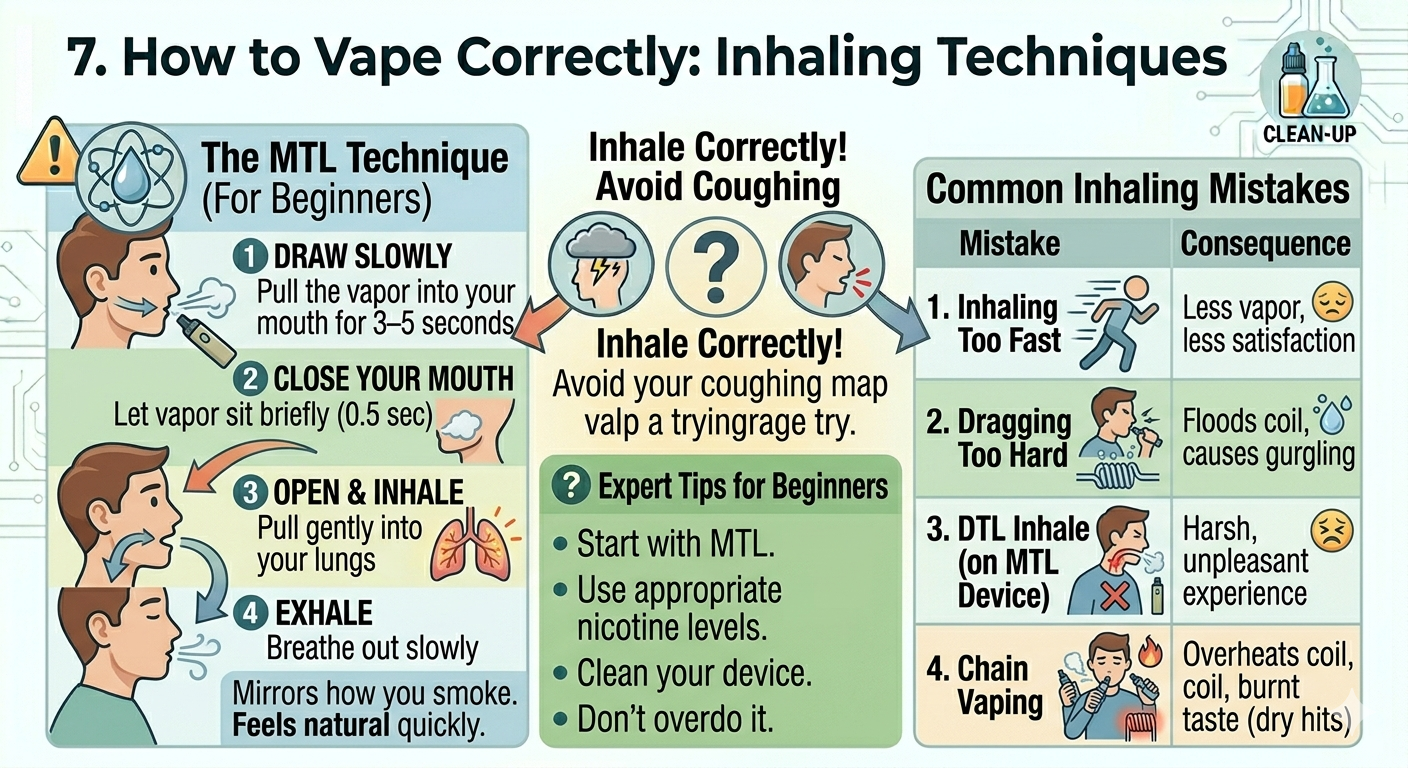
Many beginners cough on their first attempt — not because vaping is inherently harsh, but because they're using the wrong technique.
The MTL Technique (For Beginners):
- Draw slowly — Pull the vapor into your mouth for 3–5 seconds
- Close your mouth — Let the vapor sit briefly in your mouth (half a second)
- Open slightly and inhale — Pull the vapor gently down into your lungs
- Exhale — Breathe out slowly
This mirrors exactly how you smoke a cigarette. It will feel natural within 1–2 sessions.
Common Inhaling Mistakes:
- Inhaling too fast → Produces less vapor, less satisfaction
- Dragging too hard → Can flood the coil with liquid, causing gurgling
- DTL inhaling on an MTL device → Harsh, unpleasant experience
- Chain vaping → Overheats the coil and can cause burnt taste (dry hits)
8. Common Beginner Mistakes (And How to Avoid Them)
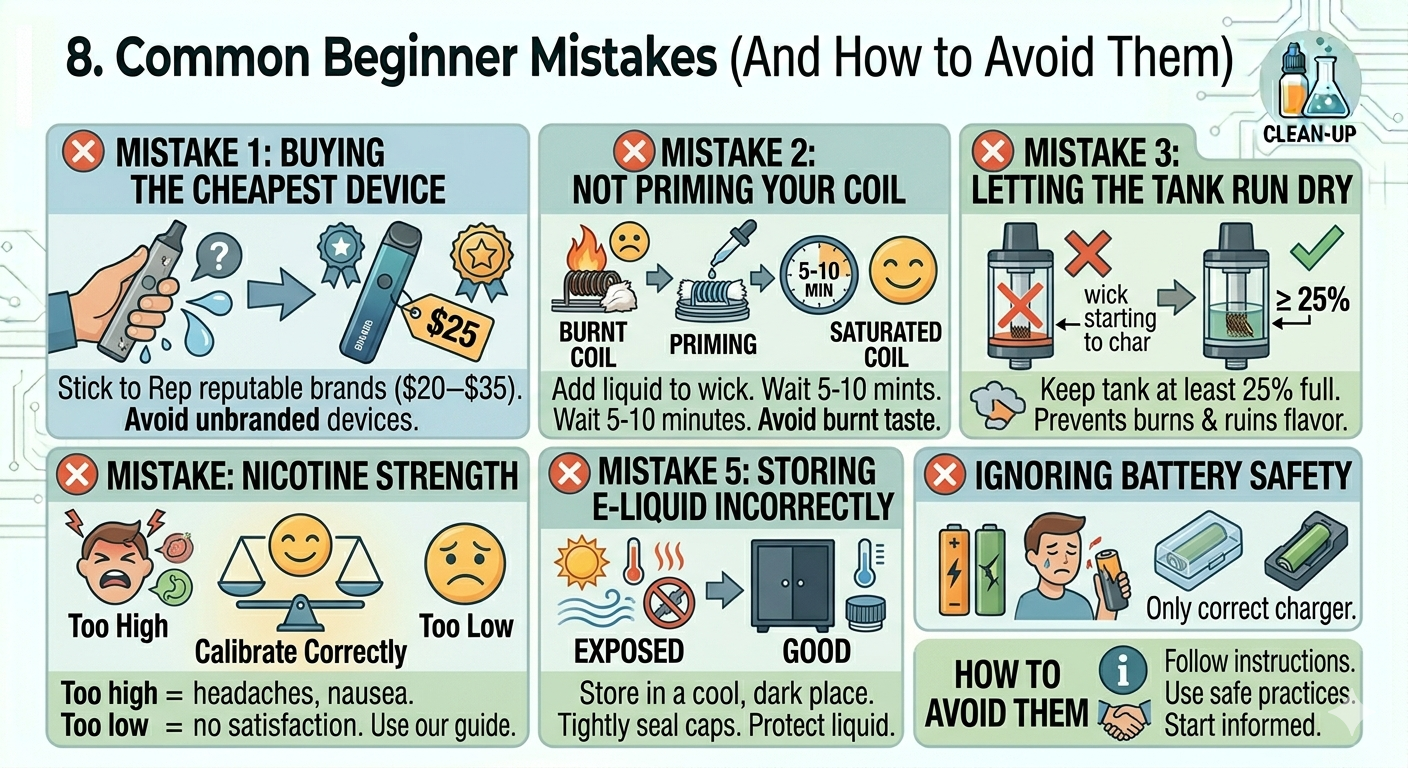
❌ Mistake 1: Buying the Cheapest Device Available
Ultra-cheap, unbranded devices often use low-quality coils and batteries. Stick to reputable brands — you can get an excellent starter device for $20–$35.
❌ Mistake 2: Not Priming Your Coil
Before using a new coil or filling a new pod, let it sit for 5–10 minutes after adding e-liquid. This saturates the wick and prevents a horrible burnt taste.
❌ Mistake 3: Letting the Tank Run Dry
Vaping on an empty or near-empty tank burns your coil and ruins the flavor. Keep your tank at least 25% full.
❌ Mistake 4: Choosing the Wrong Nicotine Strength
Too high = headaches, nausea, racing heart. Too low = no satisfaction. Use our nicotine guide above to calibrate correctly.
❌ Mistake 5: Storing E-Liquid Incorrectly
E-liquid degrades when exposed to heat, light, and air. Store it in a cool, dark place with caps tightly sealed.
❌ Mistake 6: Ignoring Battery Safety
If using a device with external batteries, never use damaged batteries, keep them in protective cases, and only use the correct charger.
9. Vaping Safety: What Every Beginner Must Know
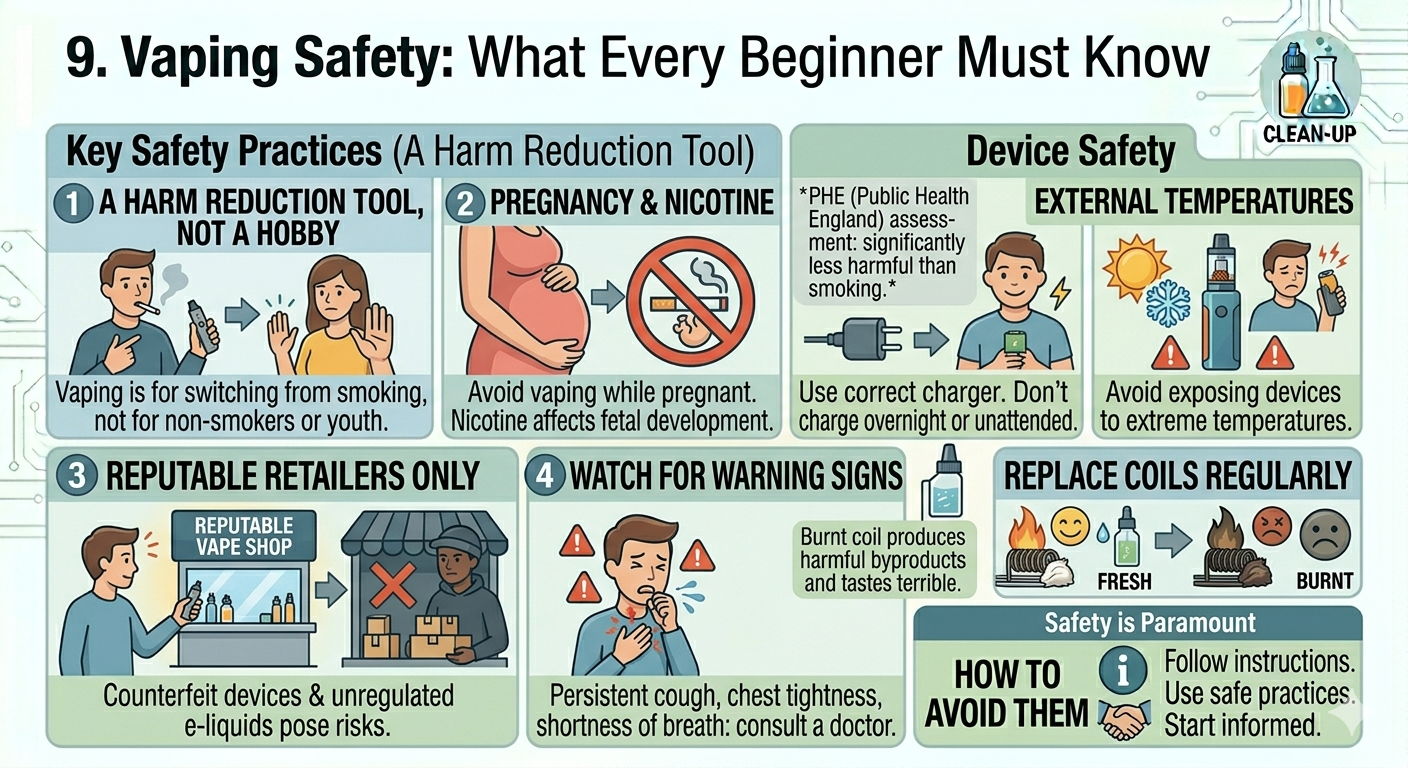
Public Health England's landmark assessment concluded that vaping is significantly less harmful than smoking combustible cigarettes. However, this does not mean vaping is risk-free, particularly for non-smokers and young people.
Key Safety Practices:
- Buy from reputable retailers — Counterfeit devices and unregulated e-liquids pose real risks
- Avoid vaping if you're pregnant — Nicotine affects fetal development
- Don't vape if you've never smoked — Vaping is a harm reduction tool, not a recreational hobby for non-nicotine users
- Keep devices away from children and pets
- Never modify devices — Tampering with vape hardware can cause battery failures
- Watch for warning signs: persistent cough, chest tightness, or shortness of breath — stop vaping and consult a doctor
Device Safety:
- Use the charger that came with your device
- Don't charge overnight or unattended
- Avoid exposing devices to extreme temperatures
- Replace coils regularly — a burnt coil produces harmful byproducts and tastes terrible
10. Vaping Laws & Regulations in 2026
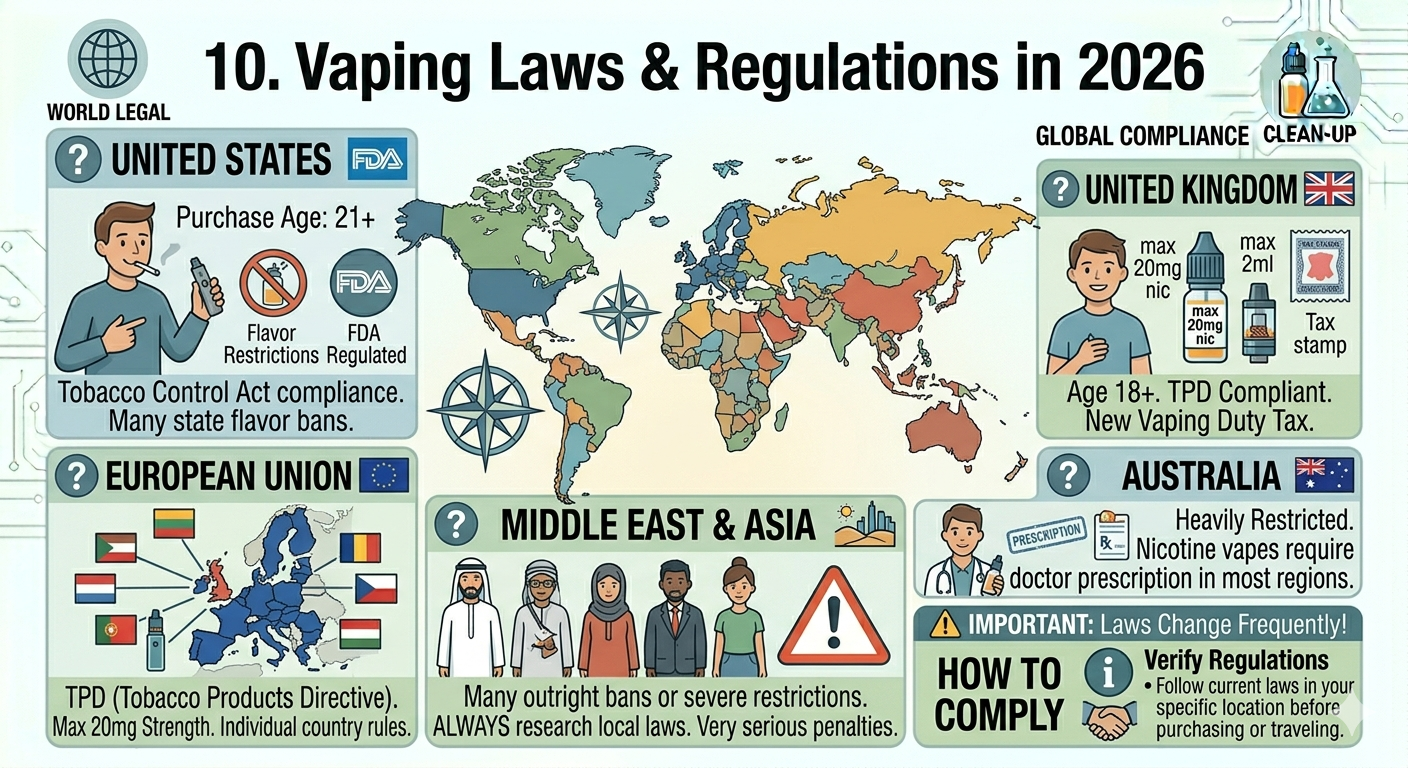
Vaping regulations have tightened significantly worldwide. Always know the rules before you buy or travel.
?? United States
The FDA regulates all vaping products under the Tobacco Control Act. Legal purchase age is 21 nationwide. Many states have additional flavor bans and restrictions.
?? United Kingdom
Legal age is 18. All products must comply with TPD regulations: max nicotine strength 20mg, max tank size 2ml. A new vaping duty tax was introduced, impacting pricing.
?? European Union
TPD regulations apply across member states. Maximum 20mg nicotine strength. Individual countries may have stricter rules.
?? Australia
Recreational vaping is heavily restricted. Nicotine vapes require a prescription from a doctor in most jurisdictions.
? Middle East & Asia
Many countries in this region have outright bans or severe restrictions on vaping products. Always research local laws before traveling with a vape device. Penalties in some countries are extremely serious.
⚠️ Important: Laws change frequently. Always verify current regulations in your specific location before purchasing.
11. How Much Does Vaping Cost? A Real Budget Breakdown
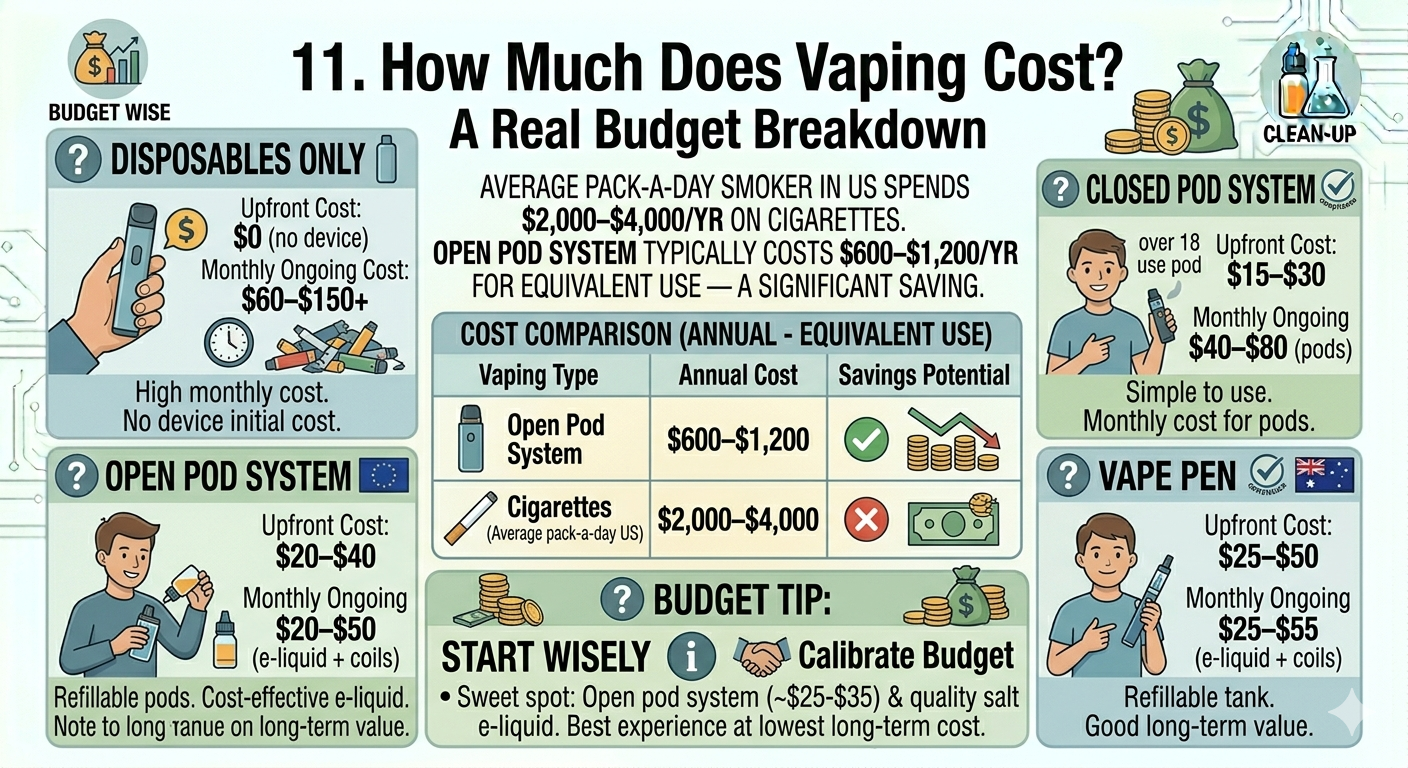
| Setup Type | Upfront Cost | Monthly Ongoing Cost |
|---|---|---|
| Disposables only | $0 (no device) | $60–$150+ |
| Closed pod system | $15–$30 | $40–$80 (pods) |
| Open pod system | $20–$40 | $20–$50 (e-liquid + coils) |
| Vape pen | $25–$50 | $25–$55 (e-liquid + coils) |
The average pack-a-day smoker in the US spends $2,000–$4,000 per year on cigarettes. An open pod system with quality e-liquid typically costs $600–$1,200 per year for equivalent use — a significant saving.
? Budget Tip: The sweet spot for beginners is an open pod system around $25–$35 combined with quality nicotine salt e-liquid. Best experience at the lowest long-term cost.
12. FAQ: Your Beginner Questions Answered
Is vaping better than smoking?
Most public health authorities agree that vaping is significantly less harmful than combustible cigarettes for current smokers. It is not, however, considered safe for non-smokers.
Will vaping help me quit smoking?
Many people successfully use vaping as a stepping stone to quit smoking entirely. Gradually reducing nicotine strength over time (20mg → 10mg → 3mg → 0mg) has helped millions.
Why does my vape taste burnt?
Either your coil needs replacing, your tank is too low on e-liquid, or you're vaping too frequently without giving the coil time to re-saturate. Prime new coils properly and keep your tank filled.
Can I vape indoors?
This depends entirely on local laws and the policies of whatever space you're in. Many places treat vaping identically to smoking. Always ask before vaping in someone else's space.
How long does a coil last?
Typically 1–3 weeks depending on usage frequency and e-liquid type. Sweet, high-VG liquids gunk up coils faster. Replace when you notice a burnt taste or significantly reduced vapor.
What's the difference between freebase nicotine and nicotine salts?
Freebase nicotine is harsher at high strengths and absorbs more slowly. Nicotine salts use benzoic acid to create a smoother experience at high nicotine concentrations — ideal for beginners who need satisfying nicotine delivery without harshness.
Are there vapes with no nicotine?
Yes. 0mg e-liquids are widely available in every flavor imaginable. Many devices can be used with any nicotine level including zero.
? Final Thoughts: Your Next Step
Vaping in 2026 is more accessible, more refined, and better regulated than ever before. If you're a smoker considering the switch, the evidence increasingly supports vaping as a significantly less harmful alternative.
Our recommendation for most beginners:
Start with a quality open pod system (Vaporesso Xros 4 Mini or Uwell Caliburn G3 Pro), pair it with a 20mg nicotine salt e-liquid in a flavor you find appealing, and give yourself 1–2 weeks to find your rhythm. Most people who struggle in the first few days find their ideal setup by day 10.
? Related Articles
- Best Pod Systems of 2026: Expert Ranked
- Nicotine Salts vs Freebase: Which Is Right for You?
- How to Choose Your First E-Liquid: The Complete Flavor Guide
- Vaping vs Smoking: What the 2026 Research Actually Shows