
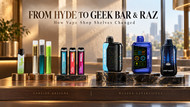
Hyde, Geek Bar & RAZ: How Vape Brands Changed
Posted by Sam JR on 13th Oct 2026
WARNING: This product contains nicotine. Nicotine is an addictive chemical. For adults 21+ only.
Written by YummyPuffs Editorial Team | Published October 13, 2026 | Approximately 7-minute read
Remember when a vape shop display was filled with small, colorful devices that looked more like markers or USB accessories than miniature electronics?
Names such as Hyde, Air Bar, and Breeze were familiar sights. Product boxes were often small, displays were simple, and there wasn't always much to distinguish one device's exterior from another beyond its shape and color.
Now look at a modern online catalog.
You'll see Geek Bar devices with elaborate screens, RAZ models with curved digital displays, Lost Mary products with visible reservoirs, and MR FOG systems made from separate components.
The change is striking.
But the interesting story of vape brand evolution isn't simply that devices became bigger or gained more features. It's how the appearance, organization, and variety of vape shop shelves changed along the way.
And brands such as Hyde, Geek Bar, RAZ, and Lost Mary help illustrate different chapters of that transformation.
Quick Answer: Vape shop shelves have changed as manufacturers introduced new device families, digital screens, rechargeable designs, and different product formats. Earlier names such as Hyde became associated with relatively compact disposable products, while newer Geek Bar, RAZ, Lost Mary, and MR FOG collections illustrate a broader range of designs. These changes explain why modern catalogs contain more distinct model families, but they do not establish that newer products are universally better.
Remember the Era of Simple Vape Displays?
Look at historical photographs of disposable electronic cigarettes and a pattern quickly emerges.
Many products had relatively simple exteriors.
Some were slender and cylindrical. Others were compact rectangles with rounded corners.
There often wasn't much electronic information visible on the device itself.
The main identifying features were the manufacturer's name, the body color, and the product packaging.
Hyde is one familiar example from this period.
Its various product families helped establish a recognizable visual identity built around compact portable designs.
But Hyde was hardly alone.
Air Bar, Breeze, and other manufacturers also became associated with recognizable exterior shapes and packaging.
The important part of this early retail story is that relatively simple devices could still have distinct brand identities.
A small object didn't need a large screen to be visually recognizable.
When the Brand Name Became the First Thing People Recognized
Think about how customers remember familiar consumer products.
Sometimes they remember a distinctive shape.
Other times they remember a color scheme, package illustration, or short product name.
For electronic-cigarette brands, those visual cues became an important part of product identification.
A customer could recognize a manufacturer without needing to examine the technical details of every model.
That is why older names remain relevant to the history of vape retail.
They help explain how the market developed recognizable brands before elaborate digital displays became common.
YummyPuffs still includes older and newer manufacturer names in its disposable vape catalog.
Seeing those names together provides an interesting snapshot of different product generations.
It doesn't mean every historical model is still manufactured or available.
It means the catalog contains brands whose identities developed at different times.
Then Geek Bar Helped Change the Look of the Shelf
Now imagine replacing a small, plain device with one that has a prominent digital display.
Suddenly the visual language changes.
The product starts resembling a compact electronic gadget rather than a simple disposable unit.
Geek Bar offers a particularly recognizable example.
Its Pulse family became associated with a distinctive body design and an electronic interface, while later generations developed different screens, shapes, and product configurations.
The manufacturer didn't use one identical design for every release.
Instead, it developed several recognizable families.
Today, the Geek Bar collection includes products such as Pulse 2, Pulse X2, Burj, Mate, and Clio.
Those names represent different device families rather than a single unchanging product.
For a closer look at individual generations, YummyPuffs already has a Geek Bar lineup guide.
The larger story here is what those generations did to the appearance of the modern retail shelf.
A display full of compact devices began sharing space with products whose screens were among their most noticeable features.
RAZ Brought Another Recognizable Design Language
RAZ also provides a useful example of the changing appearance of electronic nicotine products.
Its TN9000, LTX, and RX families have different exterior designs, with digital displays incorporated in different ways.
The brand demonstrates how a manufacturer can develop a recognizable identity while changing the shape and presentation of its individual models.
Some RAZ products have comparatively compact displays.
Others make the digital interface a more prominent part of the exterior.
The result is a broader range of product silhouettes.
That's especially noticeable when looking at the RAZ collection.
Rather than seeing one device repeated in different colors, readers encounter several generations and formats under the same manufacturer name.
This is one of the defining visual changes of modern vape catalogs.
The brand name stays recognizable while the exterior design evolves.
Why a Modern Shelf Can Look Like an Electronics Display
Here's a curious comparison.
Think about walking through a consumer-electronics store.
A display might contain wireless earbuds, compact power banks, handheld game controllers, and portable digital accessories.
Each object has its own purpose, but many share visual design ideas.
You might notice screens, curved edges, textured surfaces, and carefully integrated controls.
Similar design choices appear across modern electronic nicotine-device families.
That doesn't mean a Geek Bar or RAZ has the capabilities of a smartphone or another general-purpose gadget.
It means small electronic products can share familiar approaches to industrial design.
As those approaches became more visible in vape products, the retail shelf changed with them.
Today's product photographs often emphasize the device's exterior screen and construction as much as the packaging surrounding it.
Lost Mary Shows How One Brand Can Have Several Personalities
Lost Mary adds another chapter.
Older Lost Mary products often had relatively compact bodies with recognizable rounded shapes.
Later families introduced different exteriors, larger displays, visible reservoirs, and modular arrangements.
Consider how the older OS5000 differs visually from newer VIZ or NERA products.
They share a recognizable manufacturer identity, but their physical designs represent different approaches.
A reader unfamiliar with the model names might not immediately realize that they belong to the same broader brand family.
That's one reason the complete product name matters.
Lost Mary isn't simply one device.
It's a manufacturer name associated with several generations and constructions.
For readers interested in the individual models rather than the wider retail story, the existing Lost Mary buying guide provides separate model-level information.
The Rise of Full Kits, Pods, and Separate Battery Components
Not every change to the vape shop shelf is visible in a device's screen or outer shape.
Some changes concern how a product is packaged.
Certain electronic nicotine-device systems use separate prefilled pods and reusable rechargeable battery components.
That creates different package formats.
A manufacturer may list a complete kit, a replacement pod, and a separate battery base.
These are distinct products even when they share the same family name.
The difference is particularly important in catalog organization.
What once looked like a straightforward list of individual devices can now contain complete systems and separate compatible components.
This also explains why a product photograph alone isn't always enough to determine what comes inside a particular retail package.
The title and contents description matter.
Why Online Vape Catalogs Became More Complicated
A modern catalog has to organize much more than brand names.
It may need to distinguish different generations, complete kits, individual components, product variations, and package configurations.
Take a manufacturer such as MR FOG.
Its catalog includes MAX, SWITCH, NOVA, AURA, and other recognizable families.
An online store can't accurately describe all those products with a single generic model title.
Each family needs its own identifying information.
That doesn't necessarily mean shopping has become harder in every respect.
More detailed product pages can also make it easier to distinguish products when information is presented clearly.
But it does mean the organization of a modern catalog is very different from a simple shelf of individually packaged devices.
The Difference Between a Brand, a Series, and an Edition
This is where the naming system becomes interesting.
A brand identifies the manufacturer or commercial identity, such as Geek Bar or RAZ.
A series identifies a related product family, such as Geek Bar Pulse or MR FOG NOVA.
An edition can identify a particular variation or collection within that family.
Those are different layers of product identity.
A special edition isn't necessarily a new manufacturer.
And a newer series isn't automatically an entirely unrelated product.
As vape manufacturers introduced more product families, these naming distinctions became increasingly useful.
They help explain why modern retail listings sometimes contain several descriptive words before the actual variation name appears.
Packaging Has Changed Along With Devices
Think about the original role of a product box.
It needed to identify the product, protect its contents, and display the necessary information.
Those requirements remain, but the visual presentation of modern electronic devices has become more varied.
Some packages emphasize a device photograph.
Others highlight a display, body design, or series identity.
Seasonal collections may use special artwork.
Different generations may have noticeably different layouts.
The result is that two packages from the same manufacturer can look unlike each other while still carrying the same brand name.
That's another reason product photographs and model names should match the exact item being described.
Packaging alone should not be treated as proof of authenticity or technical performance.
What Happens to the Older Brand Names?
When newer products appear, older names don't simply vanish from the history of the market.
Reviews remain online.
Product photographs continue circulating.
Retail catalogs may preserve listings or category names.
Customers may still recognize manufacturers associated with previous generations.
This creates an interesting overlap between past and present.
A modern online store may contain familiar older names alongside products introduced much more recently.
That doesn't establish which brands are currently most popular or which products have the strongest sales.
It simply reflects the history of different product generations.
And that's useful context when reading articles published years apart.
Why More Brands Don't Automatically Mean Better Information
An online store can display hundreds of brand names, but quantity alone doesn't tell readers much about the quality of its product information.
Accurate identification matters more.
A useful listing should make it possible to understand which manufacturer and model are being discussed, what product format is represented, and whether a photograph matches the described item.
For age-restricted nicotine products, applicable legal and product-information requirements matter as well.
A modern online vape shop benefits from clear category organization rather than treating every device as interchangeable.
That's a broader lesson from the changing shelf.
The number of products may grow, but clarity still matters.
What the Modern Vape Shelf Tells Us About Consumer Design
Step back from the individual product names for a moment.
The change is remarkably similar to what happened in several other electronics categories.
Compact devices gained digital interfaces.
Manufacturers developed multiple recognizable families.
Exterior styling became more varied.
Some systems began using separate compatible components.
And online product catalogs needed more detailed organization to explain the differences.
Hyde, Geek Bar, RAZ, Lost Mary, and MR FOG illustrate different pieces of that story.
They don't all share the same history or product architecture.
But together, they show how much the appearance and presentation of electronic nicotine products have changed.
Frequently Asked Questions
Why do modern vape shops have so many brands?
Manufacturers have introduced separate product families, generations, and formats, creating a wider variety of names in retailer catalogs.
Are older Hyde products the same as modern Geek Bar devices?
No. They represent different manufacturers and product families and should not be assumed to have identical construction.
Did Geek Bar invent digital vape screens?
The existence of Geek Bar screen-equipped products does not establish that the brand invented digital displays for electronic nicotine devices.
Why are RAZ devices available in different shapes?
RAZ has introduced several product families with different housing and screen designs.
Why are some products listed as full kit and pod only?
Certain systems use separate compatible battery hardware and prefilled pods, which may be packaged together or sold as individual components.
Does a newer device always perform better than an older one?
No. Release date and exterior design alone are not reliable measures of performance or quality.
Can an old product listing still be useful?
Yes. Historical listings can help identify previous model names and appearances, although availability and specifications should be checked against current information.
Why do products from the same brand look different?
Manufacturers may use different exterior designs, component arrangements, and visual identities across their individual product families.
From a Simple Shelf to a Digital Catalog
The vape shop shelf has changed in ways that go far beyond color or package size.
Older compact products helped establish recognizable manufacturer names.
Later generations introduced prominent digital interfaces, different body designs, and new product configurations.
Brands such as Geek Bar, RAZ, Lost Mary, and MR FOG developed multiple families under familiar names.
And online catalogs evolved to accommodate that variety.
It's a story about the changing appearance of consumer electronics—and about why the brands people remember from earlier years now share space with products that can look completely different.
YummyPuffs Editorial Team
Published by YummyPuffs, sharing educational articles about electronic nicotine-product history, brand identities, and consumer-device design for adults aged 21 and older.